
When Your Home Needs More — But You're Not Sure What "More" Means
Maybe your family has outgrown your current layout. Maybe the house still has good bones, but the interior feels stuck in 1985. Or maybe you love your San Diego neighborhood too much to move, but your home just isn't working anymore.
Whatever the reason, you've probably landed on two options: build a home addition or invest in a whole-home remodel. Both are significant projects, and both can dramatically improve your daily life and your property value. But they solve very different problems.
Here's a clear, honest breakdown of each approach so you can decide which one is right for your situation.
What Is a Home Addition?
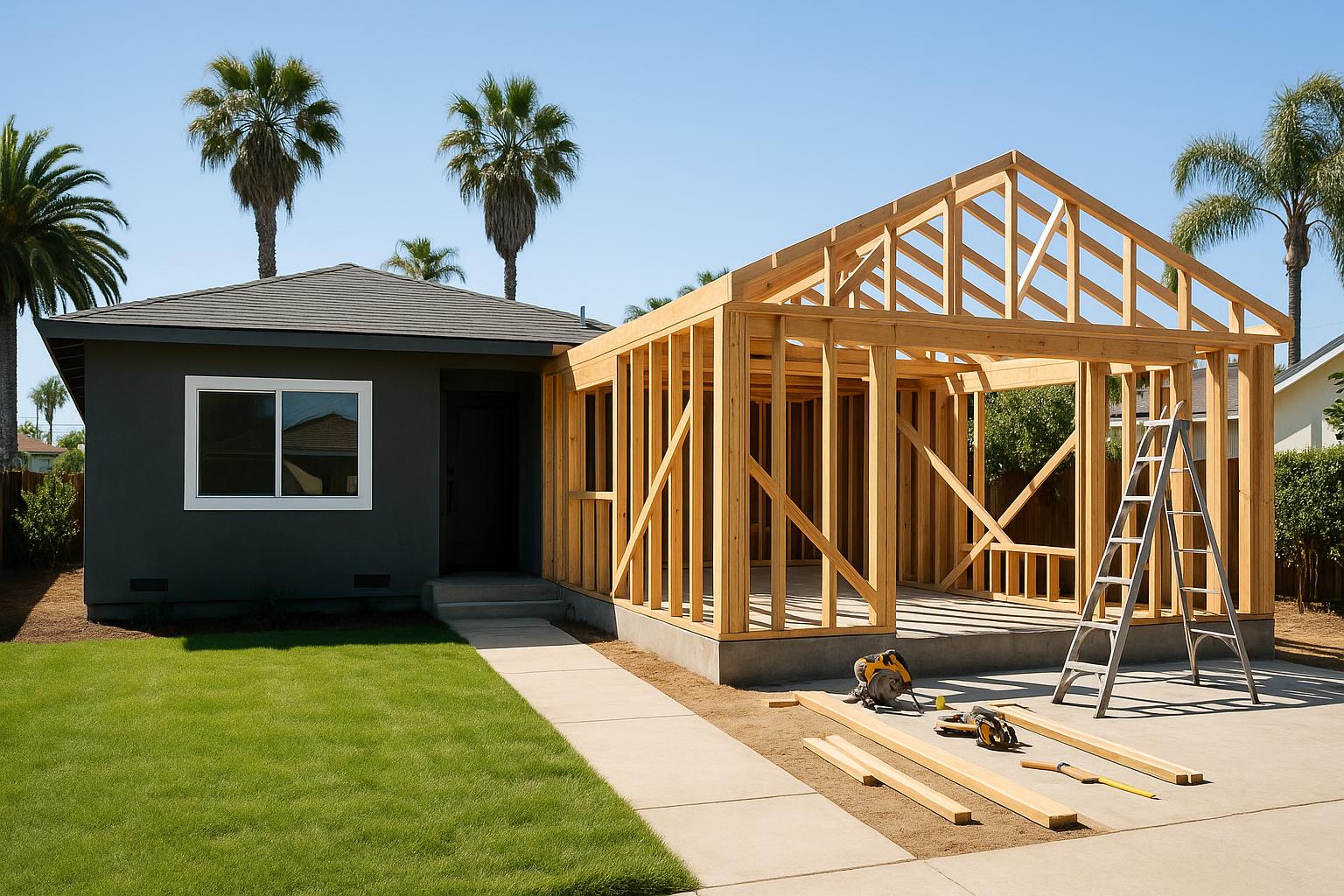
A home addition expands your home's footprint by adding new square footage. This could mean building out to the side or back of your property, adding a second story, or extending an existing room. Common home additions in San Diego include:
- An extra bedroom or primary suite
- A family room or great room extension
- A second-story addition over an existing single-story home
- A new home office or flex space
Additions are ideal when your core problem is not enough space. If your home's layout and finishes are generally fine but you simply need another room — or several — an addition is the most direct solution.
What Is a Whole-Home Remodel?
A whole-home remodel transforms the interior of your existing home without necessarily adding square footage. It can involve gutting rooms down to the studs, reconfiguring floor plans, upgrading all systems (plumbing, electrical, HVAC), and replacing finishes throughout. A typical whole-home remodel might include:
- Opening up a closed-off kitchen to create an open-concept layout
- Renovating every bathroom and the kitchen
- Replacing flooring, lighting, and fixtures throughout
- Updating electrical panels and plumbing to modern code
- Improving energy efficiency with new insulation and windows
Whole-home remodels are the right call when your home has enough square footage but the space doesn't function well, feels outdated, or has deferred maintenance issues that need to be addressed comprehensively.
Comparing Costs in San Diego
Both projects represent a major investment, but the cost structures are different.
Home Addition Costs
In the San Diego area, home additions typically range from $300 to $600+ per square foot, depending on the complexity. A second-story addition tends to cost more than a ground-level bump-out because it often requires structural reinforcement of the existing foundation and framing. A straightforward 400-square-foot bedroom and bathroom addition might land in the $150,000–$250,000 range, while a full second-story addition can easily exceed $400,000.
Whole-Home Remodel Costs
A comprehensive whole-home remodel in San Diego generally runs $150 to $400+ per square foot, depending on the scope and finish level. For a 1,500-square-foot home, that could mean anywhere from $225,000 to $600,000. The wide range reflects the difference between a mid-grade refresh and a high-end gut renovation with custom finishes.
The key takeaway: per square foot, additions tend to cost more because you're building entirely new structure. But a whole-home remodel can match or exceed the total cost of an addition if the scope is large enough.
Permits and Regulations
Both projects require permits in San Diego, and both need to comply with current building codes — including California's Title 24 energy requirements.
Home additions come with additional considerations. You'll need to verify that your lot has room to build within setback requirements and that the addition doesn't exceed your zone's maximum lot coverage or floor area ratio (FAR). If you're in a historically designated area or a neighborhood with a homeowners association, there may be design review requirements as well.
Whole-home remodels are generally more straightforward from a zoning perspective since you're working within the existing footprint. However, if you're reconfiguring load-bearing walls or making significant structural changes, engineering plans and structural permits will be required.
Either way, working with a contractor who understands San Diego's permitting process can save you weeks — sometimes months — of delays.
Timeline Expectations
Realistic timelines help you plan your life around the project, especially if you'll need to relocate temporarily.
- Home addition: Plan for 4–8 months of construction, plus 2–4 months for design and permitting. Second-story additions tend to take longer.
- Whole-home remodel: A full gut remodel typically takes 4–7 months of construction, with a similar design and permitting lead time. You'll almost certainly need to move out during a gut renovation.
In both cases, material lead times and inspection scheduling in San Diego can affect the timeline, so building in a buffer is always smart.
How Each Project Affects Property Value
San Diego's real estate market rewards both types of improvements, but in different ways.
A home addition increases your home's total square footage, which directly impacts its appraised value. Adding a bedroom and bathroom to a three-bedroom home — making it a four-bedroom — can be especially impactful because it moves the home into a higher-demand category for buyers.
A whole-home remodel increases price per square foot by bringing the condition and finish level up to or above neighborhood standards. If your home is one of the more dated properties on the block, a comprehensive remodel can close that gap and then some.
Both approaches tend to deliver strong returns in San Diego's competitive housing market, particularly in neighborhoods like La Mesa, Chula Vista, and Coronado where demand remains high.
Which One Is Right for You?
Ask yourself these questions to get clarity:
- Is your main frustration about space or about condition? If you need more rooms, an addition is the answer. If you have enough rooms but they're outdated or poorly laid out, a remodel makes more sense.
- Does your lot allow for expansion? If setbacks and lot coverage limits are tight, a remodel or a second-story addition may be your only options.
- What's your budget? If budget is a primary constraint, a remodel focused on high-impact areas (kitchen, bathrooms, open floor plan) can deliver a dramatic transformation for less than a full addition.
- How long do you plan to stay? If you're staying for 10+ years, invest in whatever makes the home work best for your family. If you might sell in a few years, focus on improvements with the strongest resale value.
Or Consider Both
Many of our San Diego clients end up combining a modest addition with selective remodeling. For example, adding a primary suite while renovating the kitchen and common areas can address both the space problem and the condition problem in a single project — often more efficiently than tackling them separately.
Start With a Conversation
The best way to figure out your ideal path is to talk through your goals with someone who's done both types of projects extensively. At Metro ADU Specialists, we help homeowners across San Diego, El Cajon, National City, and the surrounding areas evaluate their options honestly — no pressure, just clear information about what's possible, what it costs, and what makes the most sense for your home and your family.
If you're weighing a home addition against a whole-home remodel, reach out for a consultation. We'll walk your property, listen to what's not working, and help you build a plan that fits.